
Introduction
Spring constant units are one of the most important concepts in physics, especially in the study of mechanics and oscillatory motion. It provides a quantitative measure of a spring’s stiffness or resistance to deformation. Essentially, the spring constant tells us how much force is needed to stretch or compress a spring by a certain distance from its equilibrium position.
This constant is denoted by the symbol k and plays a crucial role in understanding Hooke’s Law, which is the foundational principle governing elastic behavior in springs. A higher value of the spring constant indicates a stiffer spring that requires more force to produce the same amount of displacement, while a lower value corresponds to a softer spring that stretches or compresses more easily.
Understanding the spring constant is not only essential in theoretical physics but also in practical applications such as engineering, mechanical design, vibration analysis, and material testing. By analyzing the spring constant, scientists and engineers can predict how springs will behave under different forces, design stable mechanical systems, and ensure the safety and efficiency of devices that rely on spring mechanisms.
Definition of Spring Constant
The spring constant (k) is a physical quantity that defines a spring’s resistance to deformation when a force is applied. It essentially measures how stiff or soft a spring is. The spring constant is central to Hooke’s Law, which mathematically describes the behavior of elastic materials.
Hooke’s Law
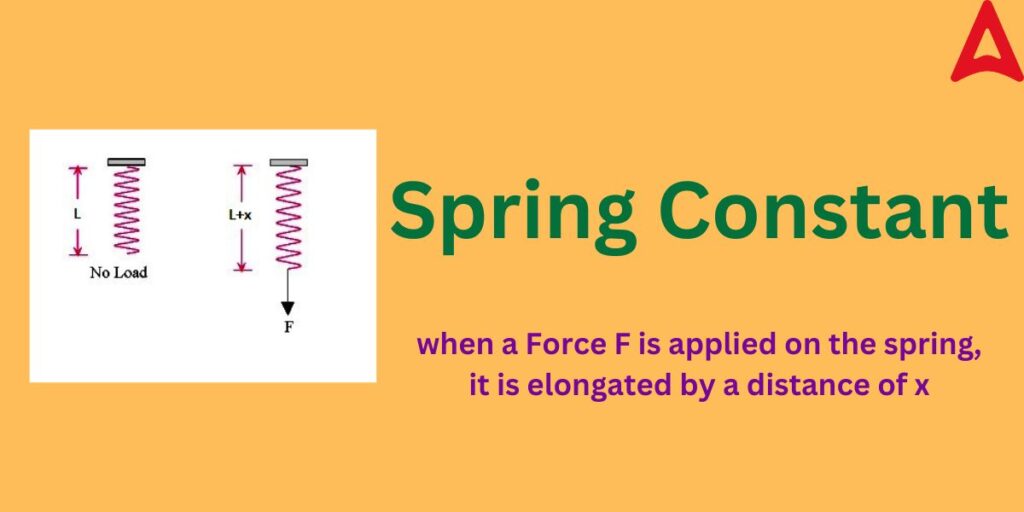
Hooke’s Law states that the force applied to a spring is directly proportional to the displacement (stretching or compression) of the spring, as long as the spring is not stretched beyond its elastic limit. This relationship can be expressed as:
F=k⋅xF = k \cdot xF=k⋅x
Where:
- F = Force applied on the spring (in Newtons, N)
- x = Displacement from the spring’s equilibrium position (in meters, m)
- k = Spring constant (in N/m)
This equation shows that the spring constant k is the ratio of the applied force to the resulting displacement:
k=Fxk = \frac{F}{x}k=xF
Physical Meaning
- A high spring constant means the spring is stiff: it requires a large force to produce a small deformation.
- A low spring constant means the spring is soft: it stretches or compresses easily under a small force.
Applications
Understanding the spring constant is essential in:
- Designing mechanical systems – to select springs that provide the correct force and motion.
- Measuring forces indirectly – using spring displacement to calculate applied forces.
- Oscillatory systems – the spring constant determines the frequency of vibration in systems like mass-spring oscillators.
In short, the spring constant is a measure of a spring’s elastic stiffness, and it is a key parameter in both theoretical physics and engineering applications.

Units of Spring Constant
The spring constant quantifies the stiffness of a spring, and like any physical quantity, it has specific units that describe its measurement in the International System of Units (SI). Understanding these units is essential for solving physics problems and applying the spring constant in real-world scenarios.
Derivation of Units
The spring constant k is defined by Hooke’s Law:
F=k⋅xF = k \cdot xF=k⋅x
Where:
- F is the applied force (measured in Newtons, N)
- x is the displacement of the spring (measured in meters, m)
Rearranging the equation to solve for k:
k=Fxk = \frac{F}{x}k=xF
Since force F has the SI unit Newton (N), and displacement x has the SI unit meter (m), the unit of the spring constant is:
[k]=Nm(Newton per meter)[k] = \frac{N}{m} \quad \text{(Newton per meter)}[k]=mN(Newton per meter)
What This Unit Means
- 1 N/m means that 1 Newton of force is required to stretch or compress the spring by 1 meter.
- A larger value of k (e.g., 500 N/m) indicates a stiffer spring, while a smaller value (e.g., 50 N/m) indicates a softer spring.
Dimensional Formula
The dimensional formula of the spring constant can also be derived from Hooke’s Law.
- Force F has the dimensional formula:
[F]=MLT−2[F] = M L T^{-2}[F]=MLT−2
- Displacement x has the dimensional formula:
[x]=L[x] = L[x]=L
Thus, the dimensional formula of k is:
[k]=[F][x]=MLT−2L=MT−2[k] = \frac{[F]}{[x]} = \frac{M L T^{-2}}{L} = M T^{-2}[k]=[x][F]=LMLT−2=MT−2
This shows that the spring constant is fundamentally dependent on mass (M) and time (T) dimensions.
Practical Significance
- Engineers use the units of the spring constant to design springs that are appropriate for specific forces and applications.
- The unit N/m helps in calculating oscillation frequencies in mechanical systems like mass-spring setups.
- It also ensures consistency in physics calculations, allowing forces, displacements, and energy storage in springs to be accurately related.
Dimensional Formula of Spring Constant
The spring constant (k) not only has units but also a dimensional formula, which helps us understand its fundamental physical nature. The dimensional formula can be derived directly from Hooke’s Law:
F=k⋅xF = k \cdot xF=k⋅x
Where:
- F = Force applied on the spring
- x = Displacement of the spring
- k = Spring constant
Step 1: Dimensional Formula of Force
Force (F) has the well-known dimensional formula:
[F]=MLT−2[F] = M L T^{-2}[F]=MLT−2
Here:
- M = Mass
- L = Length
- T = Time
Step 2: Dimensional Formula of Displacement
Displacement (x) is a measure of length, so its dimensional formula is:
[x]=L[x] = L[x]=L
Step 3: Dimensional Formula of Spring Constant
From Hooke’s Law, the spring constant is given by:
k=Fxk = \frac{F}{x}k=xF
Substituting the dimensional formulas:
[k]=[F][x]=MLT−2L=MT−2[k] = \frac{[F]}{[x]} = \frac{M L T^{-2}}{L} = M T^{-2}[k]=[x][F]=LMLT−2=MT−2
Step 4: Interpretation
The dimensional formula M T⁻² indicates that the spring constant fundamentally depends on mass (M) and time (T), but not directly on length. This dimensional insight is important in physics calculations, unit conversions, and analyzing elastic systems in mechanics.
Importance of Spring Constant Units
The spring constant is not just a number—it carries critical units (N/m) that make it meaningful and useful in both physics and engineering. Understanding the importance of these units helps in analyzing mechanical systems, designing springs, and solving real-world problems involving elastic forces.
1. Designing Springs
The unit of the spring constant, Newton per meter (N/m), allows engineers and designers to choose or create springs that meet specific performance requirements. For example:
- A car suspension system requires stiff springs with a high k value to support the vehicle’s weight.
- A delicate measuring instrument requires soft springs with a low k value to detect small forces.
Without knowing the units, it would be impossible to quantify how much force is needed for a given displacement, making precise design impossible.
2. Predicting Oscillations and Vibrations
The spring constant directly affects the natural frequency of a mass-spring system, which is crucial in mechanical vibrations:
f=12πkmf = \frac{1}{2\pi} \sqrt{\frac{k}{m}}f=2π1mk
Here:
- f = frequency of oscillation
- k = spring constant (N/m)
- m = mass attached to the spring
Knowing the units ensures that the calculation produces meaningful, physically correct results in Hertz (Hz).
3. Measuring Forces Indirectly
Springs can be used as force sensors. By measuring the displacement x of a spring and knowing the spring constant k, one can calculate the applied force:
F=k⋅xF = k \cdot xF=k⋅x
The unit N/m is crucial here because it relates the displacement to the force accurately.
4. Material Testing
The spring constant and its units help in testing the stiffness of materials. For example, by attaching a rod or wire to a spring and measuring the extension under a known load, scientists can determine the material’s elastic properties.
5. Ensuring Consistency in Physics Calculations
The SI unit N/m provides a standard measurement system, making it easy to:
- Compare springs from different manufacturers
- Solve physics problems without confusion
- Apply formulas consistently in engineering and scientific applications
The spring constant units are thus fundamental for design, analysis, and practical applications, linking theoretical physics to real-world mechanics.
Examples of Spring Constant Calculations
Understanding the spring constant (k) becomes much easier with practical examples. Here, we will go step by step to calculate k and interpret the results.
Example 1: Simple Spring Stretch
Problem: A force of 10 N stretches a spring by 0.5 meters. Find the spring constant k.
Solution:
We use Hooke’s Law:
F=k⋅xF = k \cdot xF=k⋅x
Rearranging to find k:
k=Fxk = \frac{F}{x}k=xF
Substitute the values:
k=10 N0.5 m=20 N/mk = \frac{10 \, \text{N}}{0.5 \, \text{m}} = 20 \, \text{N/m}k=0.5m10N=20N/m
Interpretation: The spring constant is 20 N/m, meaning it requires 20 Newtons of force to stretch the spring by 1 meter.
Example 2: Stiffer Spring
Problem: A stiffer spring stretches 0.1 meters under a force of 50 N. Find k.
Solution:
k=Fx=500.1=500 N/mk = \frac{F}{x} = \frac{50}{0.1} = 500 \, \text{N/m}k=xF=0.150=500N/m
Interpretation: This spring is much stiffer than the previous one. A large k value indicates a high resistance to deformation.
Example 3: Measuring Force from Spring Displacement
Problem: A spring with a spring constant of 150 N/m is compressed by 0.2 meters. Find the force applied.
Solution: Using Hooke’s Law:
F=k⋅x=150⋅0.2=30 NF = k \cdot x = 150 \cdot 0.2 = 30 \, \text{N}F=k⋅x=150⋅0.2=30N
Interpretation: A force of 30 N is required to compress this spring by 0.2 meters.
Example 4: Converting Units
Problem: If a force of 2000 dynes stretches a spring by 50 cm, find k in N/m.
(Note: 1 N = 10⁵ dynes, 1 m = 100 cm)
Solution:
- Convert force to Newtons:
2000 dynes=2000/105=0.02 N2000 \, \text{dynes} = 2000 / 10^5 = 0.02 \, \text{N}2000dynes=2000/105=0.02N
- Convert displacement to meters:
50 cm=0.5 m50 \, \text{cm} = 0.5 \, \text{m}50cm=0.5m
- Calculate k:
k=Fx=0.020.5=0.04 N/mk = \frac{F}{x} = \frac{0.02}{0.5} = 0.04 \, \text{N/m}k=xF=0.50.02=0.04N/m
Interpretation: This is a very soft spring due to the low k value.
These examples show how the spring constant can be calculated in various scenarios and how the unit N/m provides a clear understanding of spring stiffness.

Conclusion
The spring constant (k) is a fundamental concept in physics that quantifies a spring’s stiffness or resistance to deformation. By relating the force applied to the displacement of a spring, the spring constant provides a simple yet powerful way to analyze elastic systems.
The SI unit of the spring constant is Newton per meter (N/m), which clearly communicates how much force is needed to stretch or compress a spring by a unit length. Its dimensional formula (M T⁻²) further highlights its connection to mass and time, showing the deep physical principles behind everyday mechanical systems.
Understanding the spring constant is essential not only for theoretical physics but also for engineering, material testing, and design. From designing car suspensions and measuring forces to predicting oscillation frequencies in mass-spring systems, the spring constant units is a key parameter in ensuring accuracy, safety, and efficiency.
Through practical calculations and examples, we can see how different values of k correspond to soft or stiff springs, and how this knowledge allows scientists and engineers to make precise predictions about mechanical behavior.
In summary, the spring constant units is more than a number—it is a bridge between force, displacement, and real-world mechanical applications, making it a cornerstone concept in both education and industry.
FAQs
1. What is a spring constant units?
The spring constant units, denoted as k, measure a spring’s stiffness. It tells us how much force is needed to stretch or compress a spring by a unit length.
2. What is the SI unit of the spring constant units?
The SI unit of the spring constant units is Newton per meter (N/m), which represents the force required to stretch or compress a spring by one meter.
3. How is the spring constant units calculated?
Using Hooke’s Law:
k=Fxk = \frac{F}{x}k=xF
Where F is the applied force, and x is the displacement of the spring.
4. What does a high spring constant units mean?
A high spring constant units indicates a stiff spring that requires a large force to produce a small displacement.
5. What does a low spring constant units mean?
A low spring constant units indicates a soft spring that stretches or compresses easily under a small force.
6. What is the dimensional formula of the spring constant units?
The dimensional formula of k is:
[k]=MT−2[k] = M T^{-2}[k]=MT−2
This shows it depends on mass (M) and time (T).
7. Why is knowing the spring constant units important in engineering?
It is crucial for designing springs and mechanical systems, predicting oscillations, and ensuring safety and efficiency in devices like car suspensions and measuring instruments.
8. Can the spring constant units change?
Yes, the spring constant units may change if the spring is stretched beyond its elastic limit, deformed permanently, or if the spring material properties change.
9. How does the spring constant units affect the oscillation frequency?
The natural frequency of a mass-spring system is:
f=12πkmf = \frac{1}{2\pi} \sqrt{\frac{k}{m}}f=2π1mk
A larger k leads to a higher oscillation frequency, while a smaller k lowers it.
10. How do we measure a spring constant units experimentally?
By applying a known force to a spring, measuring the displacement, and using Hooke’s Law:
k=Fxk = \frac{F}{x}k=xF
This method is widely used in labs and practical applications.
11. Can springs with the same displacement have different spring constant units?
Yes, two springs can stretch the same distance under different forces. The spring with the larger force has the higher spring constant units.
12. How is the spring constant used in real life?
It is used in:
- Vehicle suspensions
- Scales and measuring devices
- Shock absorbers
- Vibration control systems
- Material testing