
Introduction
Guitar scales are fundamental building blocks of music, serving as the roadmap for melodies, solos, and improvisation. Simply put, a guitar scale is a sequence of musical notes arranged in ascending or descending order, following a specific pattern of intervals. Each scale has a root note, which acts as the tonal center, and a distinct arrangement of steps that gives it a unique sound or mood. By learning scales, guitarists gain the ability to navigate the fretboard confidently, connecting notes, chords, and riffs in a logical and musical way.
The importance of guitar scales cannot be overstated. They form the foundation for creating expressive solos, composing memorable melodies, and enhancing overall musical creativity. Practicing scales also develops finger strength, speed, coordination, and dexterity, enabling smoother transitions between notes and positions on the guitar. For beginners and seasoned players alike, scales provide a framework for improvisation and help make sense of the underlying theory behind music.
Guitar scales are essential across virtually every genre of music. In rock and metal, scales guide powerful riffs and high-energy solos. In blues, they provide the emotive “blue notes” that define the genre’s soulful character. Jazz guitarists rely heavily on scales and modes to create complex chord voicings and improvisational lines. Even in classical music, scales form the technical foundation for advanced compositions and finger exercises. Understanding scales gives guitarists the tools to explore, innovate, and express themselves across all these musical styles.
What Are Guitar Scales?
Guitar scales are more than just sequences of notes—they are the structural framework that shapes music. At their core, a scale is a set of notes ordered by pitch, arranged in a specific pattern of intervals. These intervals, which are the distances between notes, give each scale its distinct sound.
Every scale begins with a root note, which acts as the tonal center and anchors the scale. The notes that follow are determined by a fixed sequence of whole steps (two frets on the guitar) and half steps (one fret on the guitar). By understanding these patterns, guitarists can play scales in any key and in multiple positions across the fretboard.
Scales are the foundation for almost everything a guitarist does musically. They are used to:
- Create melodies: By selecting notes from a scale, guitarists can craft musical phrases that sound harmonious and intentional.
- Build solos: Most guitar solos are constructed using one or more scales, allowing the player to navigate chord changes and add expressive phrasing.
- Improve technical skill: Practicing scales strengthens fingers, improves accuracy, and develops muscle memory, enabling faster and smoother playing.
- Understand harmony: Scales are closely linked to chords, and knowing them helps guitarists understand which notes sound good over different chords and keys.
In short, scales act like a map of the guitar neck, providing a roadmap for musical exploration. Whether a guitarist is improvising a blues solo, composing a jazz piece, or practicing classical exercises, scales are the essential tool that makes the music both structured and expressive.
Types of Guitar Scales
Guitar scales come in many varieties, each with its own sound, mood, and purpose. Understanding the different types of scales allows guitarists to choose the right one for a particular song, solo, or musical idea. Below are the most commonly used guitar scales:
1. Major Scale
The major scale is commonly described as the “happy” or “bright” scale. It has a cheerful and uplifting sound and is foundational in Western music.
- Pattern of intervals: Whole step – Whole step – Half step – Whole step – Whole step – Whole step – Half step (W-W-H-W-W-W-H)
- Use: Essential for melody writing, chord construction, and improvisation in most genres, especially pop, rock, and classical.
2. Minor Scales
Minor scales have a darker, more emotional tone compared to major scales. There are three main types:
- Natural Minor: Has a sad or melancholic sound.
- Harmonic Minor: Adds a raised 7th note, giving it a dramatic, exotic feel.
- Melodic Minor: Raises the 6th and 7th when ascending, then reverts when descending
- Use: Widely used in rock, metal, blues, jazz, and classical music.
3. Pentatonic Scales
Pentatonic scales contain five notes per octave, making them simpler and easier to use for solos and improvisation.
- Types: Major Pentatonic, Minor Pentatonic
- Use: Extremely popular in rock, blues, and metal solos because of their “safe” sound that rarely clashes with chords.
4. Blues Scale
The blues scale is derived from the minor pentatonic scale, with an added “blue note” that creates a soulful, expressive sound.
- Use: Central to blues, rock, jazz, and funk solos, giving solos a distinctive emotional edge.
5. Modes
Modes are variations of the major scale that start on different scale degrees, creating unique tonal colors. Common modes include:
- Dorian: Minor with a raised 6th
- Phrygian: Minor with a flat 2nd, giving a Spanish or exotic sound
- Lydian: Major with a raised 4th, creating a dreamy feel
- Use: Widely used in jazz, fusion, progressive rock, and improvisation to add different moods and textures.
Summary
By mastering these scales, guitarists gain a versatile toolkit for playing in any genre. Whether it’s the emotional depth of minor scales, the simplicity of pentatonics, the soulful touch of blues scales, or the colorful expression of modes, understanding these scales is key to musical creativity and technical proficiency.
Why Guitar Scales Are Important
Guitar scales are far more than just patterns on the fretboard—they are essential tools that unlock a guitarist’s full musical potential. Understanding and practicing scales provides both technical and creative benefits that form the foundation for virtually every aspect of guitar playing.
1. Improve Technical Skills
Practicing scales regularly strengthens fingers, improves coordination, and develops speed. Scales train your hand to move fluidly across the fretboard, enhancing accuracy and dexterity. This makes playing complex solos, riffs, and chord progressions much easier. Over time, scales also improve muscle memory, allowing guitarists to play intricate passages without consciously thinking about each note.
2. Facilitate Improvisation and Soloing
Scales are the roadmap for improvisation. Knowing which notes belong to a scale helps guitarists create solos that are harmonically correct and musically expressive. Similarly, jazz guitarists rely on modes and extended scales to craft sophisticated solos over complex chord changes.
3. Enhance Musical Understanding
Scales provide insight into music theory and harmony. By learning scales, guitarists understand how chords are constructed, how keys work, and which notes sound good together. This knowledge allows players to compose their own music, write effective chord progressions, and transpose songs into different keys.
4. Aid Composition and Songwriting
Many memorable melodies, riffs, and hooks are based on scale patterns. By mastering scales, guitarists can create original music, explore new musical ideas, and experiment with different tonalities. Scales also help in structuring songs, ensuring that melodies and solos fit seamlessly with the harmonic backdrop.
5. Versatility Across Genres
Guitar scales are relevant across all musical genres. Whether it’s rock, metal, blues, jazz, or classical music, scales serve as the underlying framework for melody, improvisation, and expression. For instance:
- Rock & Metal: Fast solos and powerful riffs rely heavily on minor and pentatonic scales.
- Blues: Emotional expression comes from minor pentatonic and blues scales.
- Jazz: Complex harmonies and improvisation often use modes and extended scales.
- Classical: Finger exercises and technical studies are often scale-based.
Conclusion
In essence, guitar scales are the backbone of a guitarist’s skill set. They bridge the gap between theory and practical playing, giving musicians the tools to improvise, compose, and express themselves creatively. Mastering scales is not just about memorization—it’s about understanding the language of music itself and unlocking the full potential of your guitar.
How to Practice Guitar Scales
Practicing guitar scales effectively is essential for developing technical skill, fretboard knowledge, and musical creativity. Simply running up and down a scale won’t produce the same results as a focused, structured practice routine. Here’s a step-by-step guide to practicing scales efficiently:
1. Start Slow and Focus on Accuracy
- Begin at a slow tempo, ensuring each note is clean and clear.
- Use alternate picking (down-up strokes) for even tone and rhythm.
- Accuracy is more important than speed; speed comes naturally over time.
2. Use a Metronome
- Practicing with a metronome improves timing, rhythm, and consistency.
- Begin at a slow pace, and gradually speed up as your confidence grows.
- This trains your sense of timing, which is crucial for solos and improvisation.
3. Practice Ascending and Descending
- Play the scale ascending (low to high) and descending (high to low).
- Concentrate on making seamless transitions between strings and positions.
- This builds muscle memory and strengthens your understanding of scale patterns across the fretboard.
4. Explore Different Positions
- Don’t stay in one position; learn all the positions and “boxes” of a scale.
- Connecting scale positions across the neck allows you to play solos in any register.
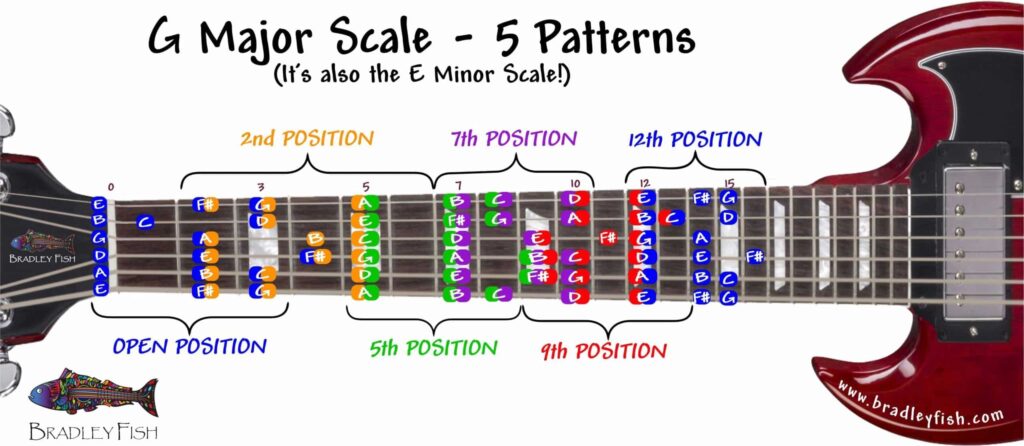
- Example: The A minor pentatonic scale has five positions; practice all to move fluidly across the fretboard.
5. Improvise Using Scales
- Play along with backing tracks in the scale’s key.
- Start by using simple patterns, then gradually experiment with bends, slides, hammer-ons, and pull-offs.
- Improvisation develops creativity and helps internalize scales musically rather than just mechanically.
6. Combine Scales with Chords
- Practice scales over chord progressions to hear how the notes interact with harmony.
- This helps in creating solos that fit naturally with the underlying music.
7. Use Daily Short Sessions
- Consistency is more effective than long, occasional practice sessions.
- Even 10–15 minutes daily can significantly improve technique, speed, and fretboard familiarity.
- Warm up with scales before moving to more complex exercises or songs.
8. Experiment with Rhythms and Techniques
- Don’t just play straight notes; practice with different rhythms (triplets, syncopation).
- Incorporate techniques like slides, bends, hammer-ons, and pull-offs to make practice more musical.
Conclusion
- Practicing scales is not just about repetition—it’s about building a deep, intuitive understanding of the guitar. By practicing slowly, using a metronome, exploring positions, improvising, and connecting scales with chords, you’ll develop both technical mastery and musical creativity. Over time, scales become second nature, giving you the freedom to express yourself fully on the guitar.

Tips for Mastering Guitar Scales
Mastering guitar scales requires more than just rote practice. With the right approach, you can make scales an integral part of your playing, improving both technical skill and musical creativity. Here are some actionable tips to help you master scales efficiently:
1. Understand the Patterns, Don’t Just Memorize
- Focus on learning why the notes fall where they do, rather than just memorizing shapes.
- Understanding intervals (whole steps, half steps) helps you play scales in any key and position.
- This knowledge allows you to improvise freely across the fretboard.
2. Visualize Scales Across the Entire Fretboard
- Don’t limit yourself to one position or “box.”
- Practice connecting scale shapes up and down the neck.
- Visualizing scales across the whole fretboard makes solos more versatile and dynamic.
3. Apply Scales to Real Music
- Use scales in actual songs, riffs, and solos rather than practicing them in isolation.
- Experiment with applying scales to chord progressions, backing tracks, or jam sessions.
- This reinforces how scales sound in a musical context and improves your ear for melody.
4. Mix Scales for Creativity
- Combine different scales (e.g., major and minor pentatonic, blues and modes) in solos to create unique sounds.
- Experimenting with scale combinations fosters creativity and helps develop your personal style.
5. Practice Both Hands Equally
- Focus on left-hand finger strength, accuracy, and positioning.
- Right-hand picking techniques (alternate picking, sweep picking, fingerpicking) are equally important.
- Balanced practice ensures fluid, clean, and expressive playing.
6. Start Slowly, Then Increase Speed
- Speed comes naturally with consistent practice.
- Begin slowly to ensure precision, then gradually increase tempo while maintaining clarity.
- Using a metronome helps track progress and keeps rhythm steady.
7. Make Practice Fun and Musical
- Turn scale practice into improvisation exercises.
- Use backing tracks, play along with favorite songs, or create mini solos.
- Enjoying the process keeps motivation high and accelerates learning.
8. Be Consistent
- Daily practice, even in short sessions, is far more effective than sporadic long sessions.
- Consistency builds muscle memory, improves fretboard familiarity, and develops long-term skills.
Conclusion
Learning guitar scales is a process that blends technical skill with musical creativity. By understanding scale patterns, visualizing them across the fretboard, applying them in musical contexts, and practicing consistently, guitarists can unlock new levels of creativity, fluency, and expression. Scales stop being mere exercises and become a natural part of your musical language.
Conclusion
Guitar scales are the foundation of a guitarist’s musical journey, bridging the gap between theory and expressive playing. From the bright and uplifting major scales to the soulful blues scales and the exotic modes, each scale offers a unique palette of sounds and emotions. By understanding and practicing scales, guitarists gain not only technical mastery—improved finger strength, dexterity, and fretboard navigation—but also the creative freedom to compose, improvise, and express themselves musically across any genre.
Whether you are playing rock riffs, jazz improvisations, blues solos, or classical exercises, scales provide the roadmap for every note you play. Consistent, mindful practice, combined with applying scales in real musical contexts, allows them to move from mere patterns into a natural part of your musical expression.
Ultimately, mastering guitar scales is not just about learning notes—it’s about unlocking the language of music itself. With dedication and curiosity, scales can transform your playing, helping you explore new sounds, create captivating solos, and elevate your overall musicianship. Every guitarist, regardless of skill level, can benefit immensely from making scales a central part of their practice. Guitar scales.
FAQs
1. What is the best scale for beginners?
The minor pentatonic scale is often recommended for beginners because it is simple, easy to memorize, and works well over many chord progressions. The major scale is also important for understanding basic music theory and building a strong foundation.
2. How many guitar scales are there?
There are countless Guitar scales, but the most commonly used are:
- Major scales
- Minor scales (natural, harmonic, melodic)
- Pentatonic Guitar scales (major and minor)
- Blues scale
- Modes (Dorian, Phrygian, Lydian, Mixolydian, etc.)
Mastering a few key Guitar scales first is more effective than trying to learn every scale at once.
3. How do I practice Guitar scales effectively?
- Start slow and focus on accuracy.
- Use a metronome to maintain rhythm.
- Practice ascending and descending the scale.
- Explore different positions across the fretboard.
- Apply scales to songs or backing tracks for musical context.
4. Do I need to memorize every scale?
Not necessarily. Understanding patterns and intervals is more important than rote memorization. Once you understand how scales are constructed, you can play them in any key or position without memorizing every single note.
5. Can scales help me improvise?
Yes! Scales are the foundation for improvisation. Knowing which notes belong to a scale allows you to create solos and melodic lines that harmonize with the chords of a song.
6. How long does it take to master guitar scales?
It depends on practice consistency, but regular practice—10–20 minutes daily—can lead to noticeable improvement within a few months. Mastery is an ongoing process as scales are tools you continually explore and apply throughout your musical journey.
7. Are scales only for soloing?
No. Scales are essential for soloing, but they also help with:
- Understanding chords and harmony
- Composing melodies
- Playing riffs
- Finger exercises and technical development
8. Should I practice scales in all keys?
Yes. Practicing scales in multiple keys ensures flexibility and allows you to play in any musical context. It also helps you understand the fretboard more deeply.