

Introduction
Central Idea definition story, an essay, or an article carries a message that the writer wants the reader to understand. This key message is what we call the central idea. In simple terms, the central idea is the most important point a writer aims to communicate through a text. It is not just a topic or subject; it is the essence of the writing—the “heart” that gives meaning to every sentence and paragraph.
Understanding the central idea is essential for effective reading and comprehension. When readers can identify the central idea, they gain a clear sense of the author’s purpose, the theme of the text, and the message intended to be conveyed. It allows readers to focus on what truly matters in the text, distinguishing main points from supporting details, examples, or minor information.
For instance, in a story about a small act of kindness, the central idea might be that helping others brings joy and strengthens community. While the story may contain many events and characters, all of them work together to support this main point. By identifying the central idea, readers can understand not only what the story is about but also the deeper lesson the author intends to teach.
In essence, the central idea acts as a guiding light for both the writer and the reader. Every story, essay, or article has a core message, and recognizing this core is what allows readers to truly understand and appreciate the text.
Definition of Central Idea
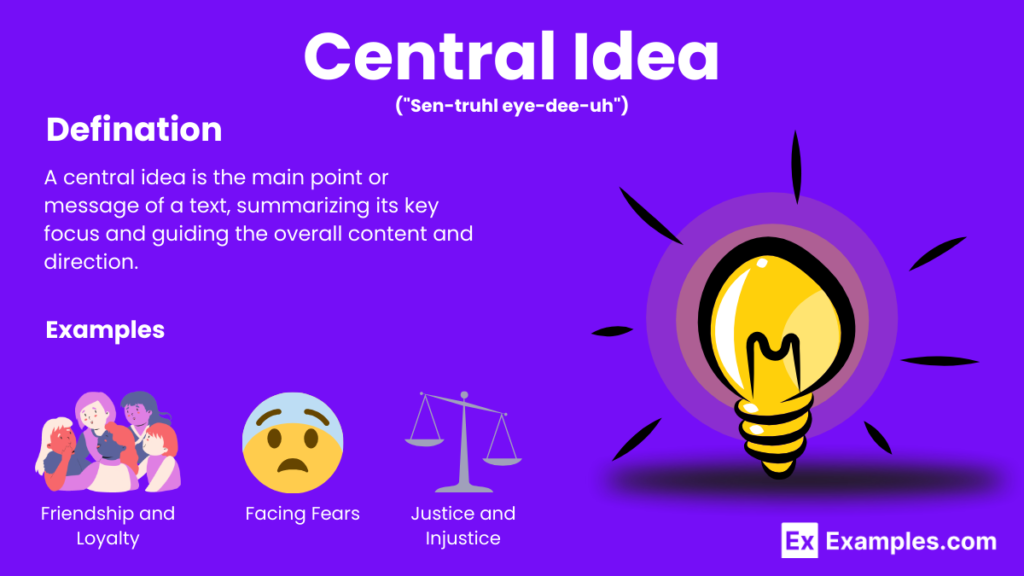
The central idea of a text is the main thought, point, or message that the author wants to communicate to the reader. It represents the essence of the text and conveys what the writer wants the audience to understand, learn, or reflect upon. Unlike the topic, which is simply the general subject of the text, the central idea expresses a complete thought or key message.
For example, the topic of a passage might be pollution, which tells us what the text is about in general terms. However, the central idea goes further by explaining the writer’s main point: Pollution harms the environment and human health, so we must take steps to reduce it. This shows the specific message that the author intends the reader to grasp.
In essays or academic writing, the central idea is often referred to as the main idea or thesis statement, and it provides a clear direction for the entire text. Every sentence, example, or argument in the text usually supports and reinforces this central idea. Understanding it is crucial because it allows readers to focus on the key message rather than getting lost in minor details or irrelevant information.
In short, the central idea is the backbone of any text. It is the guiding thought that helps readers comprehend the purpose, meaning, and significance of what they are reading.
Characteristics of a Central Idea
Understanding the characteristics of a central idea can help readers identify it more easily and writers craft more focused and meaningful texts. The central idea has several key features:
- Main Point
The main idea conveys the primary focus of the text. It is the core message around which all other details, examples, and arguments revolve. Everything in the text—whether a story, essay, or article—supports this main point, ensuring that the reader can understand the purpose and direction of the writing. - Complete Thought
Unlike a topic, which may be expressed in a single word or phrase, the central idea is a complete sentence. It conveys a full thought that explains what the author wants the reader to take away from the text. For instance, while the topic might be “Pollution”, the central idea could be: “Pollution harms the environment and human health, and we must take steps to reduce it.” - Universal Message
A strong central idea often conveys a lesson, insight, or message that is applicable beyond the specific text. This universality allows readers to connect the text to real-life situations or broader concepts. For example, a story about honesty might communicate the universal message that truthfulness builds trust and integrity. - Supported by Details
Every example, fact, argument, or description in the text is included to support the central idea. Minor details may provide context, but they all reinforce the main message. If a text lacks supporting details, it becomes difficult to understand the central idea or see its relevance.
In essence, the central idea is like the backbone of a text. It provides focus, clarity, and direction, ensuring that both the writer’s purpose and the reader’s understanding align perfectly.
Central Idea vs. Topic
While the terms topic and central idea are sometimes used interchangeably, they are not the same. Understanding the difference is essential for both readers and writers.
- A topic is the broad subject or general theme of a text. It is usually expressed in one or two words and tells the reader what the text is about in general terms.
- The central idea, on the other hand, is the specific message or point that the author wants to communicate about that topic. It goes beyond the general subject to explain the main thought or purpose of the text.
Here’s a simple comparison:
| Topic | Central Idea |
| Broad subject (one or two words) | Specific message or point |
| Example: Pollution | Example: Human activities causing pollution are damaging the environment and need to be controlled |
In short, the topic tells what the text is about, while the central idea tells what the author wants to say about it. Recognizing this difference is crucial for understanding, analyzing, and summarizing any text effectively.
How to Identify the Central Idea
- Identifying the central idea is an essential skill for understanding any text, whether it’s a story, article, or essay. The central idea is often not stated explicitly, so readers must carefully analyze the text to uncover it. Here are some practical steps to identify the central idea effectively:
- Read Carefully
Begin by reading the text thoroughly. Pay close attention to the introduction, main body, and conclusion, as the central idea is often hinted at or summarized in these sections. Avoid skimming, because important details that support the main idea may be easy to miss. - Look for Repeated Ideas
Authors frequently emphasize their main point by repeating certain words, phrases, or concepts throughout the text. Noticing these repetitions can provide strong clues about the central idea. For example, if a passage about pollution repeatedly mentions industrial waste and environmental damage, the central idea likely relates to human activities harming the environment. - Ask yourself, ‘What message is the author conveying?’”
Pause and reflect on the overall message of the text. Consider the purpose behind each paragraph and example. Asking this question helps shift your focus from minor details to the bigger picture—the main point the author wants the reader to take away. - Summarize the Text
After understanding the text and identifying repeated ideas, condense the main point into a single clear sentence. This sentence should express the complete thought that captures the essence of the text, going beyond the general topic. For instance, if a passage describes efforts to protect endangered animals, the central idea could be: “Protecting endangered species is essential to maintain ecological balance and preserve biodiversity.” - By following these steps, readers can efficiently uncover the central idea, enhancing their comprehension, critical thinking, and ability to summarize texts effectively.
Importance of the Central Idea
- The central idea plays a crucial role in both reading and writing, serving as the backbone of any text. Understanding the central idea brings clarity and purpose, making communication more effective. Here’s why the central idea is so important:
- Enhances Comprehension of Texts
Recognizing the central idea helps readers understand the main message of a text. Instead of getting lost in minor details or examples, readers can focus on what the author is trying to convey. This improves overall comprehension and allows for a deeper understanding of the text’s purpose and meaning. - Makes Writing Organized and Focused
For writers, a clear central idea ensures that every sentence, paragraph, and example supports the main message. This creates a well-structured and coherent piece of writing that communicates effectively to the audience without unnecessary digressions. - Essential for Academic Success
In academic settings, identifying and articulating the central idea is critical for reading, writing, and analyzing texts. Whether summarizing a passage, writing an essay, or preparing for exams, understanding the central idea allows students to capture the essence of the material accurately and efficiently. - Supports Critical Thinking
Recognizing the central idea helps readers distinguish between important points and minor details. This ability fosters critical thinking, enabling readers to evaluate arguments, identify evidence, and make informed conclusions based on the main message rather than being distracted by irrelevant information. - In summary, the central idea is not just a concept for academic exercises—it is a vital tool for effective reading, clear writing, and thoughtful analysis. By understanding the central idea, readers and writers alike can communicate, learn, and think more effectively.

Examples from Literature
Using examples from literature and essays can make the concept of the central idea easier to understand. By examining how authors convey their main message, readers can see the central idea in action. Here are a few examples:
- Story: The Tortoise and the Hare
In this classic fable, a slow-moving tortoise races against a speedy hare. Despite the hare’s natural advantage, the tortoise wins through consistent, steady effort.- Central Idea: Slow and steady effort leads to success.
This central idea reflects the lesson or moral of the story, showing readers the key message the author wants to communicate beyond the events of the plot.
- Central Idea: Slow and steady effort leads to success.
- Essay Topic: Climate Change
In essays discussing climate change, authors often present facts, examples, and arguments to emphasize the urgent need for action. While the essay may cover multiple aspects—such as rising temperatures, pollution, and endangered species—the central idea captures the overall message.- Central Idea: Human action is necessary to mitigate climate change and protect the planet.
This central idea summarizes the essay’s main point and unites all supporting details under a clear, focused message.
- Central Idea: Human action is necessary to mitigate climate change and protect the planet.
These examples illustrate how the central idea can be identified in both narratives and informational texts. In every case, the central idea provides clarity, conveys the author’s purpose, and helps readers understand the deeper meaning behind the text.
Conclusion
Understanding the Central Idea definition are essential for grasping the essence of any text. It allows readers to focus on the most important message the author wants to convey, making comprehension more meaningful and effective. By identifying the Central Idea definition readers can distinguish between key points and minor details, enhancing both understanding and retention of the material.
Practicing the skill of finding the central idea also benefits writers, as it encourages clarity, focus, and organization in their work. The more one identifies and articulates the Central Idea definition, the stronger their reading comprehension and writing skills become.
No matter the length or complexity of a text, the Central Idea definition is the guiding light that helps readers understand its true meaning. Recognizing this core message ensures that both reading and writing are purposeful, insightful, and impactful.
FAQs
1. How does a topic differ from a Central Idea definition?”
- A topic is the general subject of a text, usually expressed in one or two words.
- A Central Idea definition is the main message or point the author wants to communicate about that topic. For example, if the topic is pollution, the Central Idea definition could be: Pollution harms the environment and human health, so we must take steps to reduce it.
2. Can a text have more than one Central Idea definition?
- Generally, a text has one main Central Idea definition, but it can include several supporting ideas or sub-points that reinforce the main message. Each paragraph or section may highlight a different aspect, but all support the Central Idea definition.
3. How can I identify the Central Idea definition in a passage?
- Read the text carefully.
- Look for repeated ideas or emphasized points.
- Consider asking, ‘What point is the author trying to make?’
- Summarize the passage in a single sentence that captures the main point.
4. Why is understanding the Central Idea definition important?
- It improves reading comprehension.
- Helps in summarizing and analyzing texts.
- Makes writing organized, focused, and clear.
- Encourages critical thinking by separating main ideas from minor details.
5. Is the Central Idea definition the same as the thesis statement?
- In essays, the Central Idea definition is often called the thesis statement. Both express the main point of the text. The thesis statement specifically serves as a guiding sentence for an essay, while the Central Idea definition applies to all types of texts, including stories and articles.
6. Can theCentral Idea definition be implied rather than directly stated?
- Yes, in some texts, especially stories or narratives, theCentral Idea definition may be implied rather than explicitly stated. Readers need to infer it by analyzing the events, characters, and overall message of the text.
7. How does identifying the Central Idea definition help in exams or academic work?
- Identifying the Central Idea definition helps students summarize passages accurately, answer comprehension questions, and write focused essays. It ensures that answers highlight the main point rather than irrelevant details, which improves academic performance.
8. Can the Central Idea definition change throughout a text?
- The Central Idea definition of a text usually remains consistent, but a complex text may present multiple supporting ideas or sub-themes. These support the main Central Idea definition without changing it, providing depth and context.
9. Are Central Idea definition only found in written texts?
- No, the Central Idea definition can also be found in spoken content, such as speeches, lectures, or presentations, and even in visual media like films or videos. Any communication that conveys a main message can have a central idea.